Kick-off event: AI and the future of mathematics and physics - 21.10.2026
In light of recent developments, the incoming kick-off event at the Institut Henri Poincaré will take the form of a debate gathering mathematicians and theoretical physicists around the role of AI in the practice of research. Registration: indico.math.cnrs.fr/event/17376/.
Inverse Statistical Mechanics: Inferring Interactions from Materials’ Spectra
byHaina Wang
Abstract:The inverse problem in statistical mechanics aims to find microscopic structures or interactions that correspond to macroscopic properties. In my talk, I will review some challenges for common methods to extract effective interactions from the pair correlation function \( g_2(r) \) [or equivalently, the structure factor \(S(k)\)] of many-body systems, such as their effective ambiguity of solutions despite a uniqueness theorem. Next, I will introduce my work to overcome such challenges by developing an inverse methodology that is accurate, efficient, and robust to noise. This methodology has enabled us to quantify the ‘‘nonequilibriumness” of many-body systems, study the structural degeneracy (‘‘isospectral”) problem, and probe the realizability of prescribed pair correlation functions. We expect our approach to facilitate the design of self-assembly of materials with desired optical and transport properties. Finally, I will comment on how inverse statistical mechanics can be extended to active-matter systems and how the recent development of stochastic automatic differentiation may be applied to devise more efficient inverse algorithms.
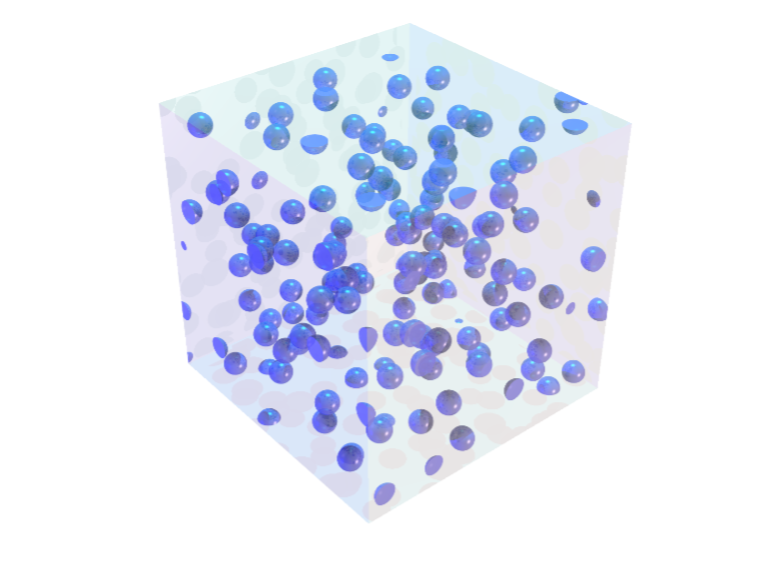
Fig 1. - Configuration of an equilibrium system with Gaussian pair statistics \( g_2(r) = 1 - e^{-\pi r^2}\) at unit number density.